B/W Rayhatching Technique by Piter Pasma
B/W Rayhatching Technique

Bio
Dutch artist Piter Pasma (1980) has been immersed in coding since the age of nine. However, it wasn't until 2019 that he truly began to identify himself as a generative artist. Pasma's fascination with algorithmic complexity within computers has ultimately led him to view NFTs as the best thing that could have happened for generative art. Drawing from his experiences in the competitive demoscene of the late 1990s, his code is concise yet powerful. Based in Groningen, the Netherlands, he is renowned for his ability to create photorealistic as well as line art based generative artworks using mathematical functions, striving for efficiency by using as few characters as possible. By fine-tuning virtual ‘black boxes’, he conjures unexpected environments that emerge from simple code, showcasing his unique ability to surprise and engage audiences. Pasma is also dedicated to fostering creativity in others, through organising for example Genuary; an annual event that challenges artists to create daily works based on 31 selected prompts.
About the Work

My artistic medium is code. For my CryptoCubes piece I used my "rayhatcher" algorithm, which is an algorithm that can turn mathematical descriptions of 3D shapes into hand-drawn-looking hatched line art. The code for this algorithm has been hand optimised to be very small, and the output is an SVG file that contains the full code inside it, as well as the output image. An SVG file can also be used with a plotter, a robot drawing machine capable of drawing lines with a pen or marker.
About This Piece
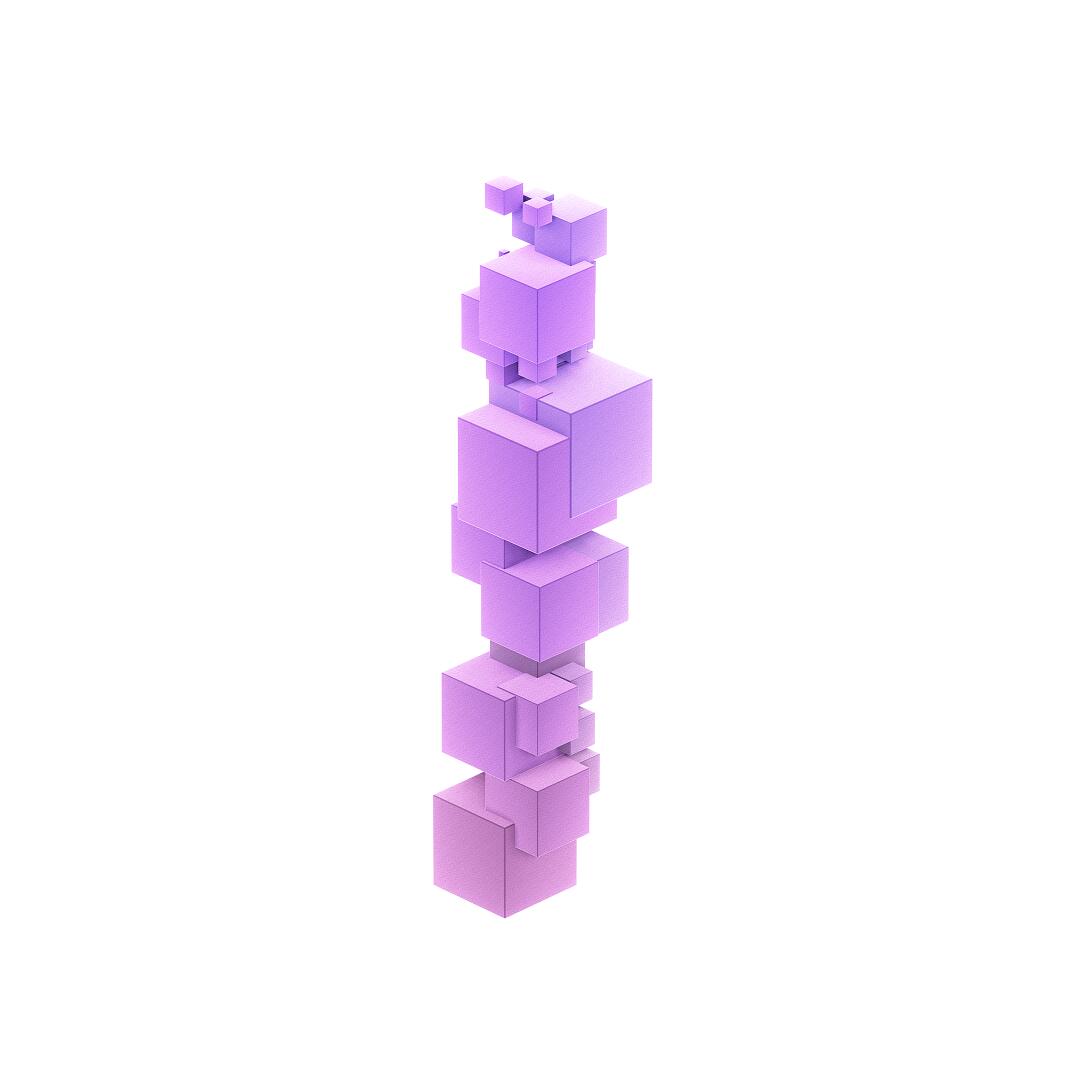
Because my rayhatcher runs fully in Javascript, without any shaders or GPU acceleration, it is a bit limited in the number of primitives (cubes) it can render. Some CryptoCubes consist of a swarm of hundreds of cubes! Fortunately there's a great variety of CryptoCubes and not all of them have this many. Looking through the different types of CryptoCubes available for me to choose from, I decided I wanted a long vertical column of cubes, but not too many. Ultimately I went with CryptoCube 224, which fit those criteria perfectly, made of only 41 cubes. Upon receiving the 3D object file for CryptoCubes, I first loaded it into Blender and exported it as a text-based format that just contained the coordinates of the cubes (which was all I needed), and then converted the text file into JSON format. Loading the objects into my rayhatcher framework, I added some surface details, a floor and a rough wall in the background. Putting the camera in a lower perspective, I quickly found a composition that I really liked. Then I spent a long time trying variations on the wall and even adding colour, but ultimately decided that one of my earlier versions looked best.
Future
NFTs provided me with the opportunity to spend most of my time exploring generative art. I am hugely grateful for all my collectors who supported me. Before NFT's a "long form" generative program would just be that, as an experience you could show it to people and they'd refresh a couple of times, and walk away with the impression of "a computer program that generates images that sort of look like these". NFTs allow for a completely new and unique experience, allowing the collector to own a single output. And that particular one is theirs, unlike all the other potential outputs. This creates a whole different dynamic, and I think that's a beautiful thing.